
Dr. C. C. Wendle had uncovered a story that was explosive—literally. An unidentified civilian employee at the Navy’s research facility in Bayview told Wendle about plans to detonate a series of explosive charges deep down in Lake Pend Oreille. Alarmed, Wendle immediately contacted Idaho Senator Herman Welker who talked with Navy officials in Washington, DC. He also enlisted Jim Parsons, Sr., longtime publicist for the Sandpoint Chamber of Commerce, who began asking questions on his own.
By the time the story hit the newspapers in early February 1952, the rhetoric had heated up. The underwater explosions were described as “bombing,” a term that helped rally opposition to the Navy’s plans. Senator Welker did nothing to calm the waters, claiming that the “bombing” would “completely eradicate all fish life from the lake.”
As the story emerged, it became apparent that state officials had known about the Navy’s plans since at least August 1951 when the Department of Fish and Game granted preliminary permission for the tests. Governor Len Jordan told Parsons that he did not believe that any explosion would cause irreparable harm to the lake. The Fish and Game Commission, while concerned about the fish, was reluctant to interfere with the national defense program. They downplayed Welker’s hyperbole, saying that the explosions should not affect fish outside the immediate test area. To minimize any damage, they were working with the Navy to set small preliminary charges to chase fish away from the larger blast site.
Both sides of the issue had compelling arguments. The Navy claimed the tests were vitally important to the defense effort because the controlled explosions would provide information needed to keep sailors safe on their ships. In the midst of the Korean War, with World War II still fresh in memory, it was hard to dispute any national defense claim.
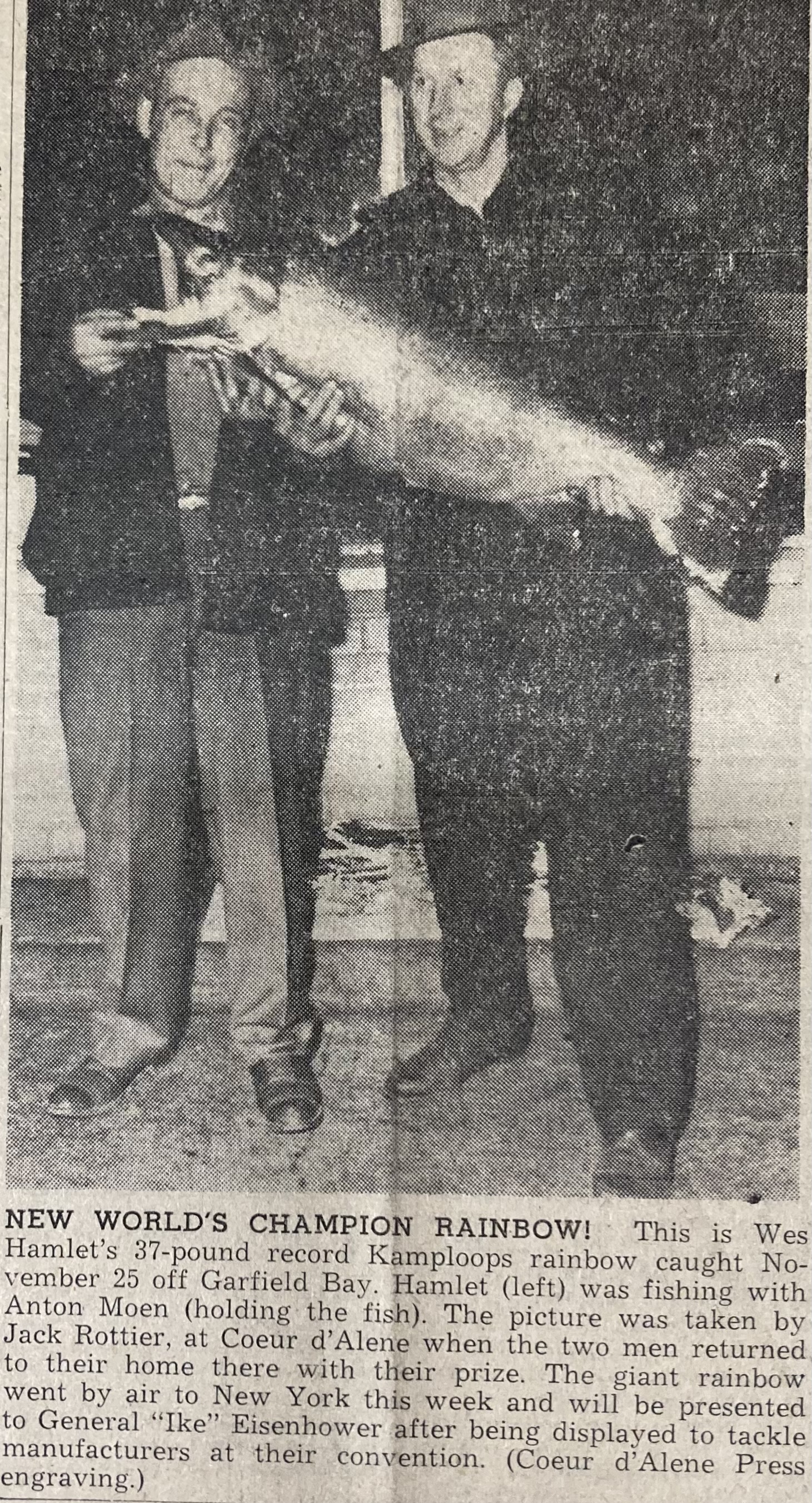
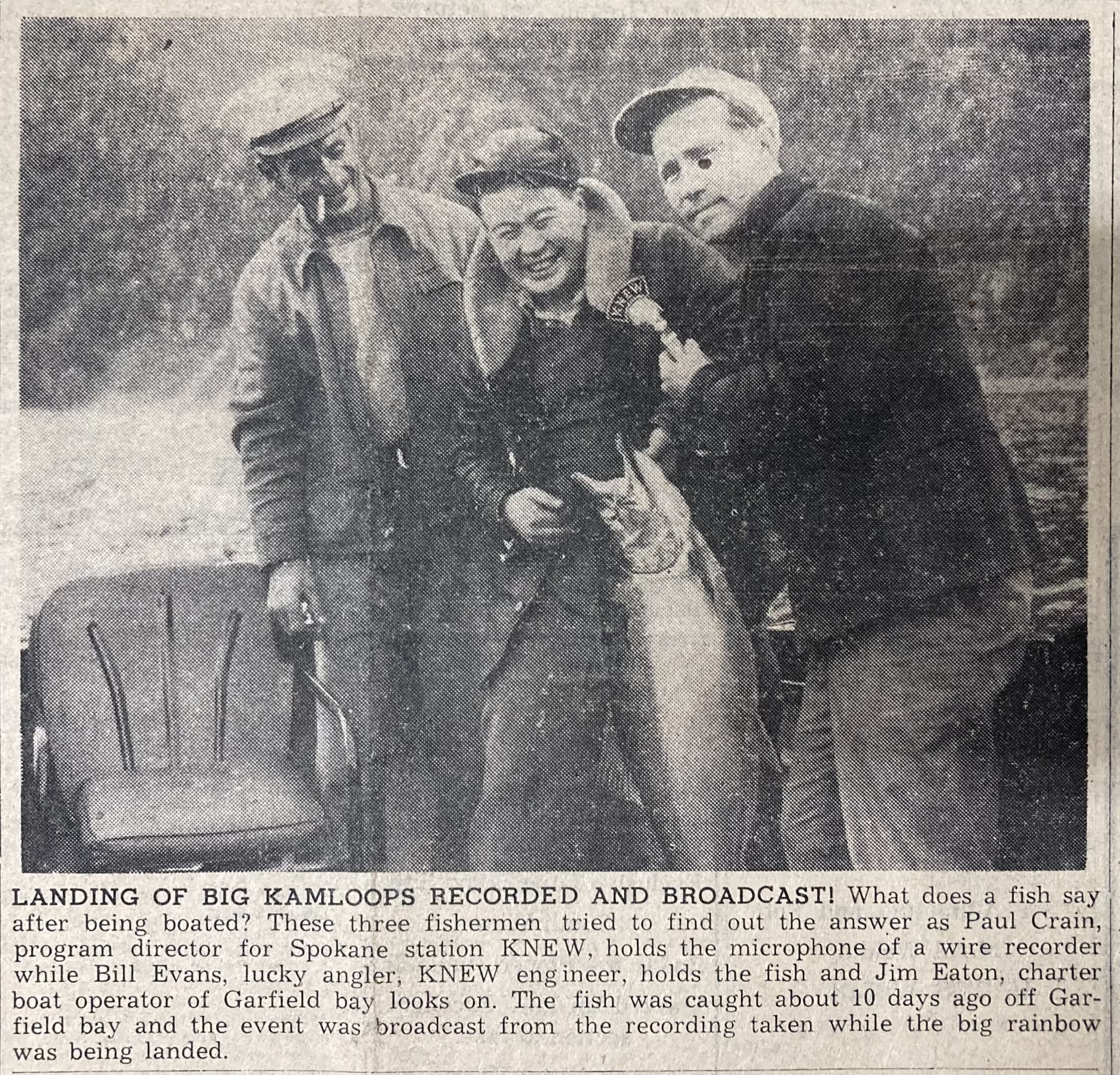
Those concerned about the fish also had a strong case. Photos of smiling fishermen holding world-record Kamloops had brought national attention to Lake Pend Oreille, attracting 60,000 people the previous summer and bringing much needed revenue to the local economy.
Public opinion throughout the region turned quickly and decisively against the Navy. The Sandpoint News-Bulletin explained, “What has aroused the people of this region as much as anything else seems to be the misnomer ‘bombing.’ People have envisioned planes dropping loads of bombs indiscriminately in the lake to the danger of fish and fishermen.” The paper suggested that the Navy would need to make “a mighty strong case to satisfy an aroused opinion.”
Less than a week later, the Navy launched its public relations campaign with a hearing at Sandpoint’s Community Hall. Captain A. G. Mumma, commanding officer at the Navy’s Bayview research facility, described the tests and presented data to show that no harm would befall any fish. The explosions would take place in deep water near Cape Horn, he said. The first test would be in April and, if there were no unprecedented damage to fish, the Navy planned several more. Tim Vaughan, regional biologist for Fish and Game, supported these tests and hoped to get accurate data on the effects of the detonations. To mollify critics, Navy officials promised to restock the lake to make up for any fish killed.
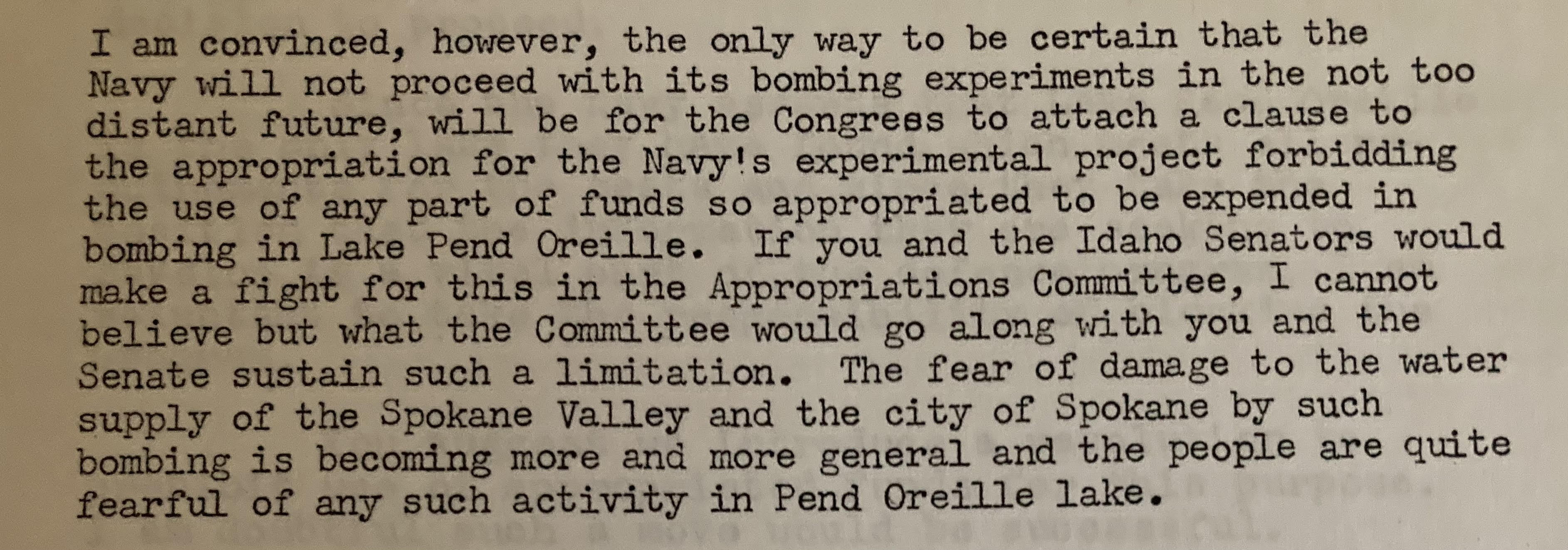
While residents of North Idaho were concerned about fish, the people in Spokane worried about their drinking water. The city and surrounding area, with 200,000 people, depended on the Spokane aquifer for its water supply. Deep underground gravel channels at the south end of Lake Pend Oreille carried water to the aquifer, which accounted for a sizable percentage of Spokane’s water. City officials were concerned that the deep blasts might irreparably damage the gravel beds, adversely impacting the water supply.
Clarence Dill, former Democratic senator from Washington, met with Captain Mumma in mid-February 1952. Mumma explained the reasons for the tests but admitted that the Navy would proceed with the “bombing” regardless of test results. Dill promptly wrote to Washington Sen. Warren G. Magnuson to urge him to join forces with the Idaho delegation to introduce a bill to prohibit funding for the tests. While there is no evidence of such legislation, Magnuson did contact Dan A. Kimball, Secretary of the Navy, to say that he would hold the Navy responsible for any damage to the Spokane water supply. Kimball responded with additional assurances that the explosions would not damage the city’s water in any way.
The Bonner County Sportsmen’s Association voted to formally protest any explosive tests in Lake Pend Oreille. They worried that the first test would lead to many more in the future. A delegation, led by Dr. Wendle, met with a similar organization in Spokane to discuss how to proceed. Before the end of February, they had petitions circulating in Sandpoint and Coeur d’Alene to “protest the use of the water in Lake Pend Oreille for explosive experiments.” Within a matter of days, 6,000 people had signed. The protests caught the attention of national media, and one Sunday, CBS featured Captain Mumma, Jim Parsons, Sr., and Willard Taft, a Spokane city councilman.
The Sportsmen’s Association continued its opposition, lobbying Governor Jordan and questioning Fish and Game’s initial approval of tests. How was it, they wondered, that the department charged with protecting wildlife would grant the Navy permission to destroy wildlife? They worried that Lake Pend Oreille, one of the finest fishing lakes in the country, would become an explosives testing ground. Meanwhile Spokane councilman Taft threatened court action.
By early March, Senator Magnuson told Dill that he had done all that he could to stop the tests, including taking the issue to top officials. The Secretary of the Navy had said that Lake Pend Oreille was the only location that met all of the requirements for the tests and that the tests were “a vital part of the defense program.” Reluctant to challenge further, Magnuson said he had to “rely on the good faith of the Secretary and his associates, when they assert their investigation shows that much of the fear on the part of the local residents is ill-founded.”
Unlike Magnuson, the people of North Idaho were not reassured, and their protest petitions, along with the lobbying and adverse publicity, soon achieved a positive outcome. On March 7, 1952, Dan A. Kimball, Secretary of the Navy, wrote to Senator Magnuson that the Navy had “indefinitely postponed the explosive tests,” citing both the protests as well as a request from Governor Jordan.
The 1952 fishing season opened May 3, the 7th annual observance of Kamloops & Kokanee Day. In anticipation of this popular occasion, the Sandpoint News-Bulletin wrote, “The lake the navy tried unsuccessfully to ‘bomb’ is going to get ‘bombed’ anyway—with hundred of flashing plugs and gaily painted lures.” While the winning fish that day did not set any records, everyone celebrated the big win for the lake’s fish.
The furor over the proposed “bombing” in Lake Pend Oreille taught both the Navy and Idaho officials a valuable lessons on the need for transparency. In the spring of 1952, citing the protests over the explosive testing, the Idaho State Land Board decided to hold a public meeting over the Navy’s request to moor a barge permanently on the lake. This electronics barge, with four civilian scientists and technical employees, would be anchored off Cape Horn and used in the measurement of underwater acoustics, with no explosives or poisonous materials involved. This research continues today at the Navy’s Acoustic Research Detachment at Bayview.

References:
Proposed Heavy Underwater Blasts Planned in Pend Oreille Protested, Sandpoint News-Bulletin, 7 February 1952, 1:7-8; Vital Navy Underwater Tests Will Go Forward in April in Pend Oreille, Sandpoint News-Bulletin, 14 February 1952, 1:7-8; Torrent of Protests Roll in After Navy Announces Pend Oreille Tests, Sandpoint News-Bulletin, 14 February 1952, Sec. 2, 1:1-3; Clarence C. Dill, Spokane, to Warren G. Magnuson, Washington, D.C., 15 February 1952, Folder 1, Box 89, Accession No. 3181-3, Warren G. Magnuson Papers, Manuscripts & University Archives Division, University of Washington Libraries; Push Opposition To Lake Blasts, Sandpoint News-Bulletin, 21 February 1952, 1:2; Dan A. Kimball, Department of the Navy, Office of the Secretary, Washington, D.C., to Warren G. Magnuson, Washington, D.C., 25 February 1952, Folder 1, Box 89, Accession No. 3181-3, Warren G. Magnuson Papers, Manuscripts & University Archives Division, University of Washington Libraries; Warren G. Magnuson, Washington DC, to Dan A. Kimball, Secretary of the Navy, Washington DC, 26 February 1952, Folder 1, Box 89, Accession No. 3181-3, Warren G. Magnuson Papers, Manuscripts & University Archives Division, University of Washington Libraries; Effect of Explosive Charges Under Water Analyzed by State Biologist, Sandpoint News-Bulletin, 28 February 1952, 1:4-5; Navy Blasts in Pend Oreille Are To be Carried Out, Kimball Indicates, Sandpoint News-Bulletin, 28 February 1952, 1:7-8; Warren G. Magnuson, Washington, DC, to C.C. Dill, Spokane, 29 February 1952, Folder 1, Box 89, Accession No. 3181-3, Warren G. Magnuson Papers, Manuscripts & University Archives Division, University of Washington Libraries; Albert G. Mumma, David Taylor Model Basin, Washington, DC, to Willard Taft, Commissioner of Public Utilities, Spokane, 29 February 1952, Folder 1, Box 89, Accession No. 3181-3, Warren G. Magnuson Papers, Manuscripts & University Archives Division, University of Washington Libraries; Warren G. Magnuson, Washington, D.C., to Clarence C. Dill, Spokane, 3 March 1952, Folder 1, Box 89, Accession No. 3181-3, Warren G. Magnuson Papers, Manuscripts & University Archives Division, University of Washington Libraries; Status of Blasts in Lake Remain Live Topic of Discussion in Region, Sandpoint News-Bulletin, 6 March 1952, 1:1-2; Dan A. Kimball, [Secretary of the Navy], Washington DC, to Governor Len Jordan, Boise, 7 March 1952, Folder 1, Box 89, Accession No. 3181-3, Warren G. Magnuson Papers, Manuscripts & University Archives Division, University of Washington Libraries; Albert G. Mumma, David Taylor Model Basin, Washington DC, to Willard Taft, Commissioner of Public Utilities, Spokane, 7 March 1952, Folder 1, Box 89, Accession No. 3181-3, Warren G. Magnuson Papers, Manuscripts & University Archives Division, University of Washington Libraries; Navy’s Explosive Tests in Pend Oreille Lake Ordered Postponed, Sandpoint News-Bulletin, 13 March 1952, 1:7-8; Furor Over Tests Regrettable, Says Explosives Expert, Sandpoint News-Bulletin, 20 March 1952, 1:6; Tests in Pend Oreille Are Definitely Scrapped, Sandpoint News-Bulletin, 3 April 1952, 1:1; Horde of Fishermen Expected at Pend Oreille Saturday, Sandpoint News-Bulletin, 1 May 1952, 1:7-8; Public Hearing on Mooring of Barge, Sandpoint News-Bulletin, 8 May 1952, 1:6; Mooring of Navy Barge Is Subject Of Friday Hearing, Sandpoint News-Bulletin, 22 May 1952, 1:6; https://www.navsea.navy.mil/Home/Warfare-Centers/NSWC-Carderock/Who-We-Are/Bayview-Idaho/


 North Idaho Past/Present